


Handpieces & Motors
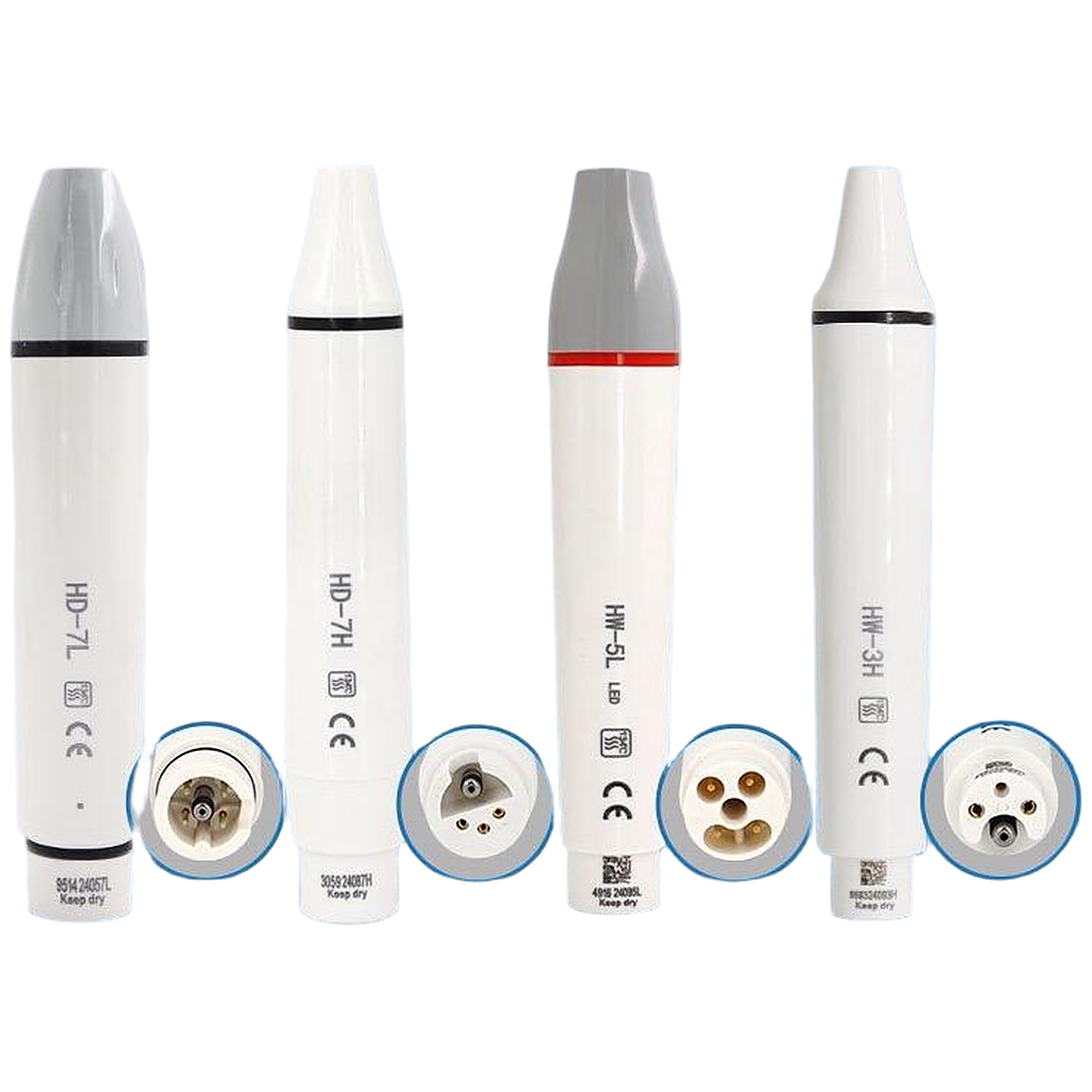
Ultrasonic Scaler Handpiece - HD-7L / HD-7H / HM-5L LED / HM-3H
- Models: HD-7L / HD-7H / HM-5L LED / HM-3H
- Type: piezoelectric ultrasonic
- Connector: 4 styles available
- Autoclavable
- Product description: Replacement piezoelectric ultrasonic scaler handpieces in four models, including one LED version. Four connector styles to match the common scaler units. Autoclavable, body marked for sterilisation.
A scaler that has lost power is usually not a dead unit. The generator is a transformer and a circuit board, and it either works or it does not. What fails is the handpiece: the stack inside it slowly depolarises, the water line scales up, and the connection at the base corrodes from repeated autoclaving. Replacing the handpiece brings the unit back to its original output for a fraction of the cost of a new machine, and it takes a minute rather than a service call.
Signs the handpiece is the part at fault
The tip stops oscillating at the pressure you are used to and you find yourself turning the power up week by week. The handpiece body gets warm in the hand during a full-mouth debridement. Water dribbles rather than sprays, or sprays sideways from a cracked collar. Scaling becomes slow and the patient flinches, which is the tip vibrating at the wrong amplitude rather than cutting cleanly. Any one of these points at the handpiece, not the generator.
Confirm it before ordering: fit a known-good handpiece to the same unit. If the power comes back, the handpiece is the fault. If it does not, the problem is in the cable, the connector at the unit, or the generator, and a new handpiece will not fix it.
Four models, four connector styles
These are piezoelectric handpieces in four versions. HD-7L and HM-5L have a grey grip; HD-7H and HM-3H are white. HM-5L carries an LED at the tip, which is the version to specify for posterior sextants and for patients who will not keep their mouth open wide enough to get light on the distal surfaces. The other three are unlit and suit operators who already work with a headlight or a mirror-based technique.
The connector at the base is the part that has to match. Four connector styles are supplied to fit the main families of scaler units, and the end faces differ in pin count and pin layout. Send us the make and model of the unit you are running, or a photograph of the connector on the old handpiece, and we will match it. Fitting the wrong connector either will not seat or will seat and leak.
| Parameter | Value |
|---|---|
| Models | HD-7L, HD-7H, HM-5L LED, HM-3H |
| Type | Piezoelectric ultrasonic handpiece |
| Body colour | HD-7L and HM-5L: grey grip; HD-7H and HM-3H: white |
| Illumination | LED on HM-5L LED only |
| Connector | Four styles, matched to the scaler unit on order |
| Sterilisation | Autoclavable, symbol marked on body |
| Packing | Single piece, with tip wrench |
Fitting a tip without damaging the stack
Hand-tightening a scaler tip is the fastest way to shorten the life of a new handpiece. A tip that is not torqued properly works loose and overheats at the joint; a tip over-tightened by hand can crack the thread in the stack. Use the torque wrench supplied with the tip range and follow the tip maker's setting. Check the water port is clear before the first use, because a blocked port will cook the stack within a few minutes of running dry.
After each patient, clean and sterilise by autoclave following the cycle used for your existing handpieces. Do not leave the handpiece soaking in cold disinfectant, and do not put it in an ultrasonic bath. Both attack the seal at the base, which is where most handpiece leaks begin.
Ordering
Tell us the scaler unit you are running and how many handpieces you keep in rotation. Mixed orders of LED and unlit versions are quoted together, and spare tip wrenches can be added to the same shipment.
Related Products


Handpiece Cable and Holder Set
Handpiece cable with stainless holder set. Six position holder block a

Automatic Handpiece Holder Val
Automatic handpiece holder valve that switches air and water when the
Categories
- Endodontics
- Burs, Polishers & Abrasives
- Handpieces & Motors
- Restorative & Prosthodontics
- Imaging & Digital Dentistry
- Orthodontics
- Unit Parts & Accessories
- Dental Instruments
- Implant & Biomaterials
- Preventive & Whitening
- Infection Control & Disposables
- Dental Lab & Materials
- dental equipment
- Loupes & Accessories
Latest News
Contact Us
Contact: Mario
Phone: +8613482534556
Tel: +86-574-62913789
Add: No.33 West Road, Gaoqiao Town, Ningbo, Zhejiang, China