


Burs, Polishers & Abrasives
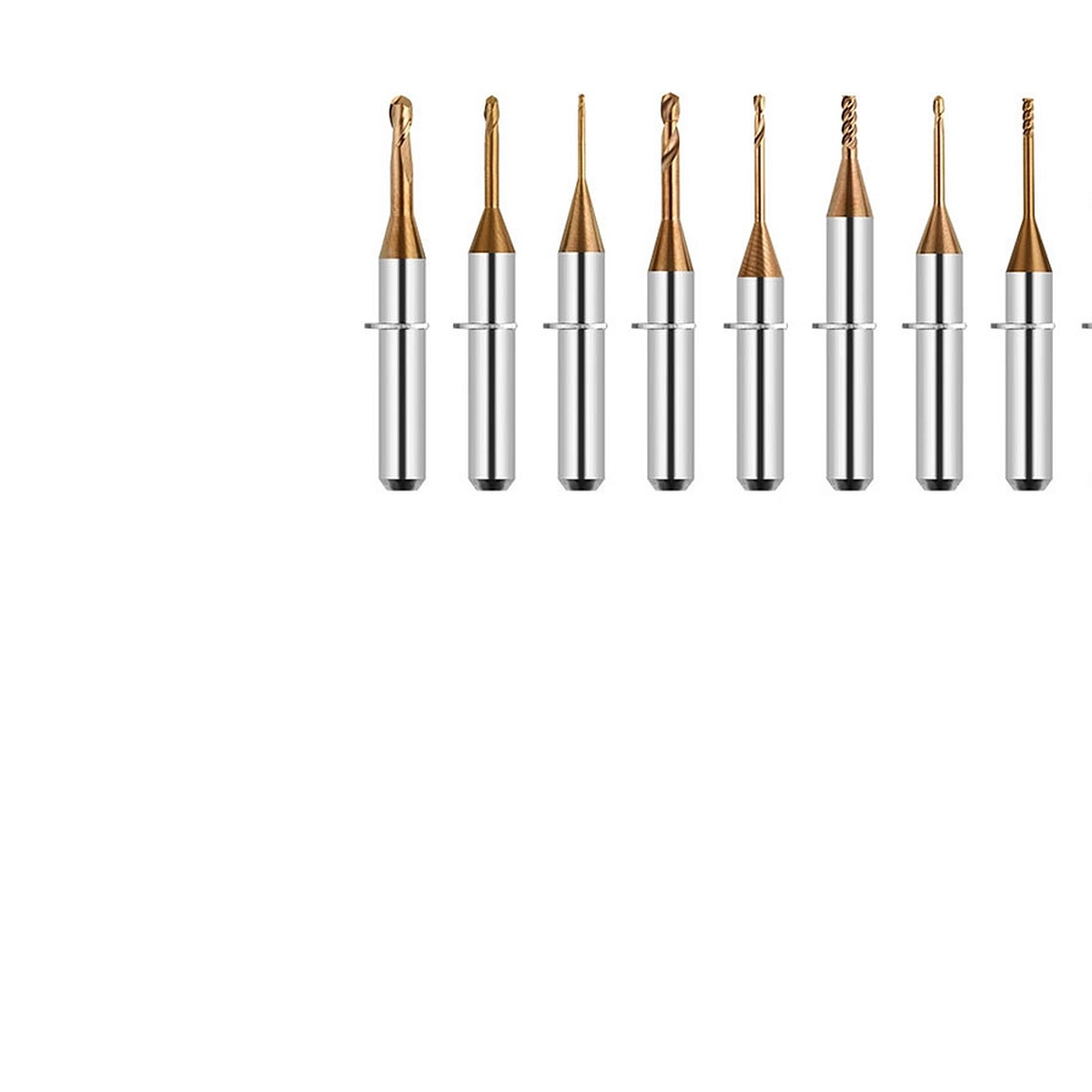
Titanium Milling Burs for CAD/CAM – VHF, Cradle, Imes Icore and Arum
- Machines: VHF, Cradle B51/B52, Imes Icore 350i, Arum, Aidite AMW-400
- Shank: 3 mm / 4 mm / 6 mm depending on machine
- Flutes: Ø0.5–3.0 mm, ball, flat, bull-nose and drill
- Use: custom abutments, titanium blanks, frameworks
- Product description: Titanium milling burs for CAD/CAM machines: VHF R5/S2/S5/Z4, Cradle B51/B52, Imes Icore 350i, Arum and Aidite AMW-400. 3 mm, 4 mm and 6 mm shanks.
Titanium is the material that separates a milling bur from a milling bur that works. It work-hardens under a dull edge, it welds to the flute when the coating fails, and it generates heat that goes straight into the abutment. A zirconia bur run in titanium will cut for a while and then start burning the surface — which is why the geometry and coating here are specified per material rather than shared across the range.
These cover the machines most laboratories use for titanium work: VHF (R5, S2, S5, Z4), Cradle (B51, B52), Imes Icore 350i, Arum and Aidite AMW-400, plus the Rachmill and LuhLuh platforms. Shank diameter is what differs between them — 3 mm on VHF, 4 mm on the Arum and Rachmill type machines, 6 mm on the Cradle D6 — so the machine model has to be named before an order is picked.
Two examples of the shape sets
| Machine | Shank | Overall | Flutes | Example cross-reference |
|---|---|---|---|---|
| VHF R5 / S2 / S5 / Z4 | 3 mm | 32 / 35 mm | Ø2.0, Ø1.5, Ø1.2, Ø1.0, Ø0.6 | M200-R4-35, M100-R2-35, M060-R2-35 |
| Cradle B51 / B52 (D6) | 6 mm | 50 mm | 3.0, 2.5, 2.0, 1.5, 1.0, 0.5 mm | T1–T12 set, R1.5 / R1.0 / R0.5 geometry |
| Imes Icore 350i | per machine | — | ball, flat, drill | on request |
| Arum / Rachmill | 4 mm | 50 mm | Ø2.0 to Ø0.6 | on request |
The Cradle D6 set is the most complete of these — twelve tools numbered T1 to T12, including a drill (T4) and bull-nose (T8) that neither the VHF nor the Arum sets carry. If you are milling custom abutments rather than just turning a titanium blank flat, that drill and the bull-nose are what cut the screw channel and the emergence profile.
Why the coating is the whole argument
Titanium has a low thermal conductivity, so heat stays at the cutting edge instead of leaving with the chip. A coated flute with a low friction coefficient keeps that heat down and stops the titanium from pressure-welding to the edge. Once welding starts, the bur is not dull — it is destroyed, and it takes the surface finish of the abutment with it. This is also why titanium burs are not interchangeable with zirconia burs of the same diameter: different rake, different coating, different life.
How many to hold
Titanium work is usually low volume and high value, so the failure that hurts is not wear — it is having one broken drill and a custom abutment case waiting. The useful stock rule is to hold two of every tool the job cannot proceed without (the drill and the bull-nose on the Cradle set) and one of each finishing shape, rather than an even spread across all twelve.
Ordering
Supplied in protective tubes. Because the shape mix is machine-specific, the practical way to order is to send the machine model plus the tool numbers you already use — we will match the set and flag anything where the geometry differs. Mixed sets across two machines can be packed together.
Related Products
Dental Micro Brush Applicators
Disposable dental micro brush applicators for bonding agents, etchants


Glass Ceramic Burs for CAD/CAM
Glass ceramic burs for milling and adjusting lithium disilicate and fe


Zirconia Diamond Polishing Dis
Zirconia diamond polishing discs and wheels in graded grits for pre-si
Categories
- Endodontics
- Burs, Polishers & Abrasives
- Handpieces & Motors
- Restorative & Prosthodontics
- Imaging & Digital Dentistry
- Orthodontics
- Unit Parts & Accessories
- Dental Instruments
- Implant & Biomaterials
- Preventive & Whitening
- Infection Control & Disposables
- Dental Lab & Materials
- dental equipment
- Loupes & Accessories
Latest News
Contact Us
Contact: Mario
Phone: +8613482534556
Tel: +86-574-62913789
Add: No.33 West Road, Gaoqiao Town, Ningbo, Zhejiang, China