


dental equipment
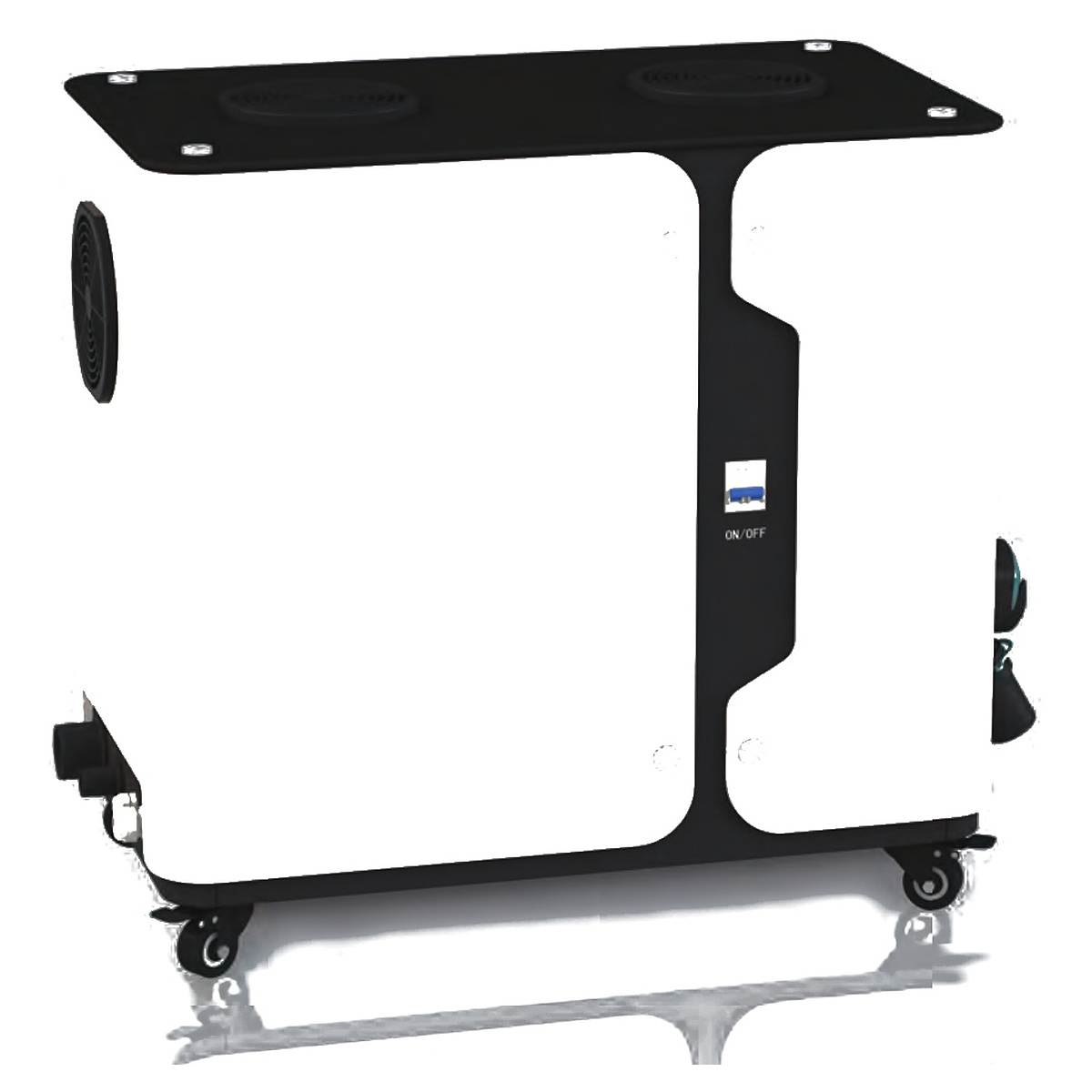
Dental Suction Unit
- Type: central unit, cabinet on castors
- Tank: stainless, automatic flush
- Control: microprocessor, remote monitoring
- Exhaust: external bacterial filter
- Product description: Central dental suction unit on castors with stainless separation tank, automatic flushing cycle, per-chair control and external bacterial exhaust filter.
Suction is the least discussed and most felt part of a dental surgery. When it works, nobody notices. When it does not, the assistant is working with one hand, the mirror fogs, the patient swallows, and every procedure takes longer than it should.
This is a dental suction unit built around a stainless separation tank and a microprocessor control. The tank is the part that matters: it takes the solids and the bulk of the liquid out of the airstream before the air reaches the pump, and it does it in a vessel that can be opened, emptied and cleaned at the end of the day rather than a filter that has to be replaced.
Automatic flushing
After the surgery closes, the unit flushes the lines and the tank on a timed cycle. This is not a convenience feature. Residual blood and amalgam sludge left in a line overnight sets into a film that narrows the bore, and a suction line that has narrowed does not fail suddenly - it fails gradually, over months, until the assistant realises that the suction has been weak for a year. A unit that flushes itself is a unit whose suction performance at year three is the same as at month one.
Multiple chairs, one unit
The unit runs several chairs from one pump, with the control system managing which chair draws what so that opening a second suction does not halve the first. The evidence that this is not working is a chair that loses suction when the neighbouring chair starts - if that happens on an installation, the pipe sizing is wrong, not the pump.
The exhaust
Air that leaves the pump has passed through the mouth of a patient, and it leaves with an aerosol of whatever was in it. The unit takes an external bacterial filter on the exhaust, and that filter is the difference between an aerosol discharged into the room and an aerosol discharged outside it. Route the exhaust to the outside of the building wherever the wall allows; a filter in the plant room is a second-best solution and it has to be changed on schedule to remain one.
| Parameter | Value |
|---|---|
| Type | Central dental suction unit, cabinet on castors |
| Control | Microprocessor, per-chair status, remote monitoring |
| Separation | Stainless tank, automatic flushing cycle |
| Water and air separation | Three-stage, in the tank assembly |
| Exhaust | External bacterial filter |
| Power and flow | Confirmed against the chair count on order |
| Installation | Plant room or utility area, exhaust to outside |
Sizing it
A suction unit is sized by the number of chairs that can be in use at once, not by the number of chairs in the practice. Two surgeries where only one is used at a time need less than two surgeries running simultaneously with two assistants. Tell us the chair count, how many run at once, and the pipe run from the plant room to the furthest chair, and we will confirm the model - a unit that is undersized for the pipe run reads as a weak pump, and no amount of servicing will fix it.
Noise
The unit belongs in a plant room or a cupboard, not in the surgery. If it has to sit in the clinical area, the enclosure and the castors mean it can be moved, but the noise of a pump in the room is the reason most practices end up building a cupboard for it later.
Related Products



Categories
- Endodontics
- Burs, Polishers & Abrasives
- Handpieces & Motors
- Restorative & Prosthodontics
- Imaging & Digital Dentistry
- Orthodontics
- Unit Parts & Accessories
- Dental Instruments
- Implant & Biomaterials
- Preventive & Whitening
- Infection Control & Disposables
- Dental Lab & Materials
- dental equipment
- Loupes & Accessories
Latest News
Contact Us
Contact: Mario
Phone: +8613482534556
Tel: +86-574-62913789
Add: No.33 West Road, Gaoqiao Town, Ningbo, Zhejiang, China