


Vet Biopsy & Sampling
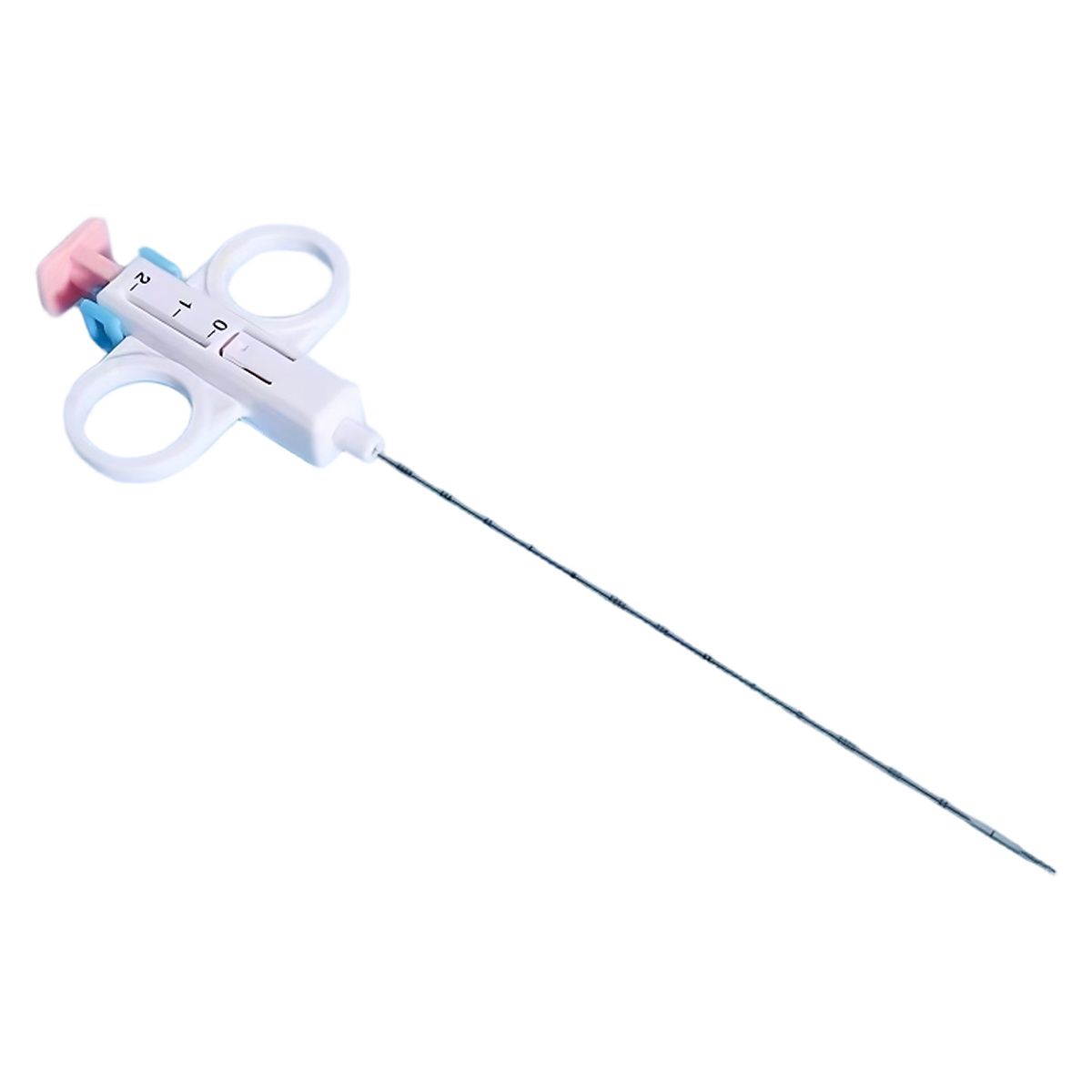
Disposable Core Biopsy Needle
- Type: spring loaded, single use
- Throw: 3 positions, pre-set
- Handle: two-ring with selector
- Sterility: supplied sterile
- Product description: Single-use spring-loaded core biopsy needle with three-position throw selector (0 / 1 / 2) for soft tissue, mammary, hepatic and renal sampling in dogs and cats.
A core biopsy is the difference between a cytology sample that says "suspicious" and a histopathology report that says what the mass is. Fine needle aspiration gives cells; a core needle gives architecture, and architecture is what a pathologist needs to grade a tumour, distinguish an inflammatory lesion from a neoplastic one, and tell you whether the margins of a resected mass were clean.
This is a single-use core biopsy needle with a two-ring handle and a spring-loaded throw. The slider behind the handle has three positions marked 0, 1 and 2, which set how far the needle advances when the mechanism is triggered: a short throw for a thin or fragile organ, a longer throw for a solid mass where a full core is needed. The specimen is captured in the notch behind the cutting cannula and is delivered intact when the needle is withdrawn.
Choosing the throw
The throw is the distance the cutting cannula travels past the stylet notch. Set it too long in a kidney or a liver and the needle passes through the organ and out the other side; set it too short in a firm mass and the notch fills with crushed tissue that no pathologist can read. In practice: short throw for kidney, spleen and any small or thin structure, long throw for a solid subcutaneous or mammary mass, and the middle setting for anything in between.
Technique
- Plan the tract - a core biopsy takes a cylinder of tissue, so the needle has to pass through the lesion and not stop short of it
- Stabilise the mass - a mass that moves away from the needle gives you a sample of fat; hold it against a firm surface or between finger and thumb
- Fire, then rotate and withdraw - rotating the needle a half turn before withdrawal cuts the core free instead of pulling it out of the notch
- One pass per needle - the cutting edge is sharp once; a second pass through the same needle gives a crushed sample
| Parameter | Value |
|---|---|
| Type | Single-use core biopsy needle, spring loaded |
| Handle | Two-ring, with throw selector marked 0 / 1 / 2 |
| Throw | Three positions, adjustable before firing |
| Gauges | Several, confirmed on order |
| Sterility | Supplied sterile, single use |
| Application | Soft tissue, mammary, hepatic, renal and splenic sampling |
After the pass
Put the core straight into formalin, not onto a swab - a core that dries on gauze is a core the pathologist will describe as artefact. If the sample is going for both histology and culture, take two passes with two needles rather than splitting one core. Watch the site for a few minutes: a renal or hepatic biopsy can ooze for longer than the procedure took, and pressure for five minutes is cheaper than a transfusion.
Coagulation status is worth knowing before the needle goes in. A patient with a platelet problem or a clotting deficit that would be trivial for a skin biopsy is a bleeding risk for a liver core, and the decision to biopsy should be made with that in mind rather than after the fact.
Ordering
Supplied individually or in boxes by gauge and length. Tell us the tissue you sample most and the average size of the mass, and we will recommend the gauge and the throw setting to order as the standard, with the other gauges as a mixed pack.
Categories
Latest News
Contact Us
Contact: Mario
Phone: +8613482534556
Tel: +86-574-62913789
Add: No.33 West Road, Gaoqiao Town, Ningbo, Zhejiang, China