


Dental Lab & Materials
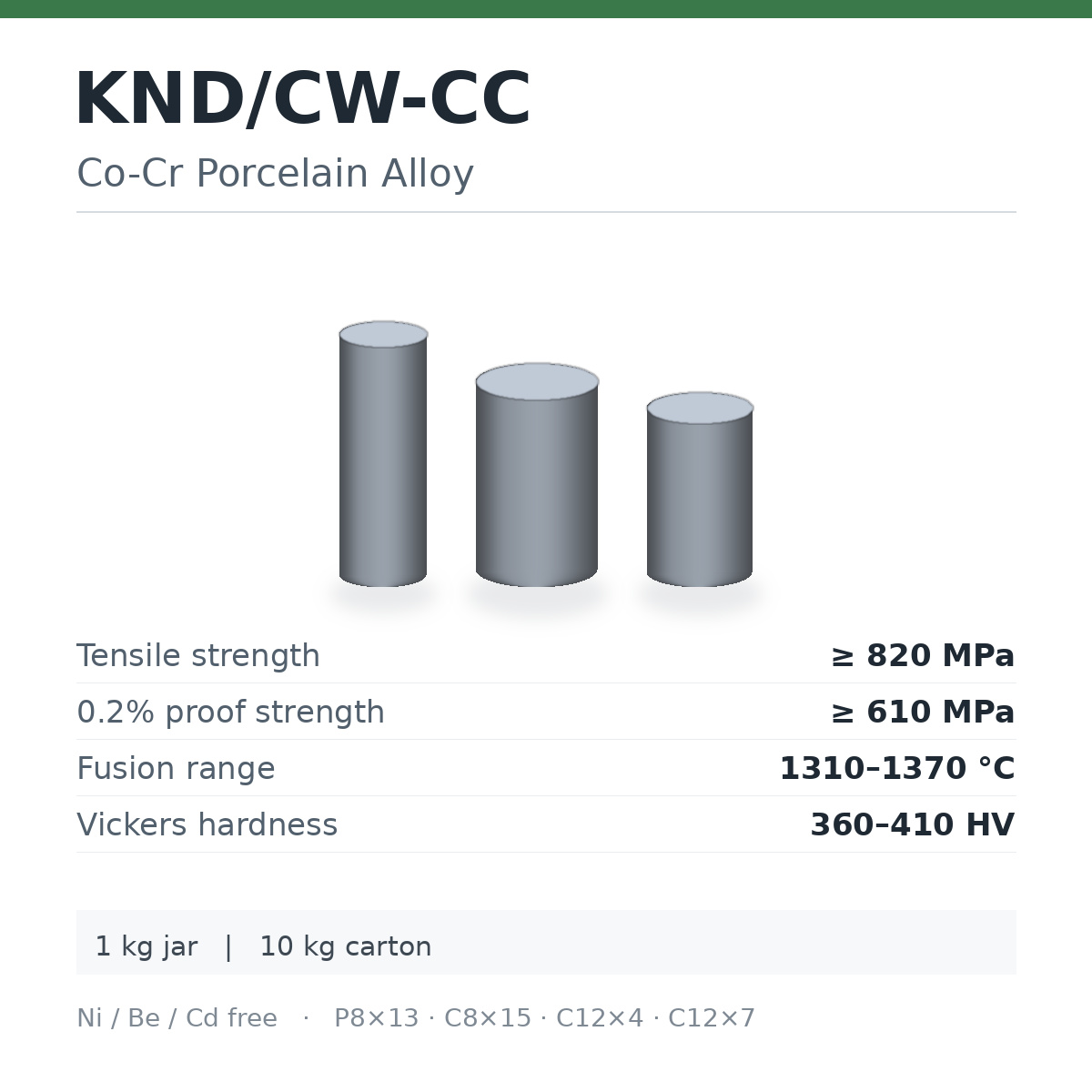
Dental Casting Alloys – Co-Cr and Ni-Cr for Crowns, Bridges and Frameworks
- Material: Co-Cr-Mo(-W) and Ni-Cr-Mo, vacuum melted
- Models: KND/CW-CC, CW-H, CW-KZ, CW-PA, CW-NP
- Ingot forms: P8×13 plate, C8×15, C12×4, C12×7 cylinder
- Packing: 1 kg jar / 10 kg carton, quote on request
- Product description: Vacuum-melted Co-Cr and Ni-Cr dental casting alloys in 1 kg jars, five grades for porcelain-fused crowns, bridges, RPD frameworks and Type 4/5 dentures. Quote on request.
Casting alloy is the one consumable a metal-ceramic laboratory cannot substitute: it decides whether a long-span bridge holds its shape through firing, whether a clasp keeps its spring after a dozen bends, and whether the porcelain bond survives in the mouth. This range covers both directions — cobalt-chromium for strength and biocompatibility, nickel-chromium for cost.
Co-Cr series — CW-CC, CW-H and CW-KZ
All three are vacuum melted and refined, which is what keeps gas porosity out of the casting and reduces the bubbles and cracks that show up after porcelain firing.
CW-CC is the grade we recommend by default for porcelain-fused crowns and bridges. It is cobalt-chromium-molybdenum-tungsten with trace rare-earth additions, and contains no nickel, beryllium or cadmium. The tungsten sets thermal expansion at 14.0–14.2 ×10⁻⁶/°C, the range most commercial porcelains are built around — the alloy is reported to run with VITA, Shofu, Noritake, Dentsply and Ivoclar systems. Tensile strength is ≥820 MPa with ≥12% elongation, so long spans resist deformation but still grind and adjust without cracking.
CW-H is the framework grade: nickel-free, higher elastic modulus, known in China as "high-elastic steel" because clasps keep their retentive force and survive repeated bending, and it takes a good electrolytic polish. CW-KZ is the Type 4/5 denture alloy; unlike the other two it contains about 10% nickel, a deliberate trade for castability, since it flows into thin saddles and major connectors that stiffer Co-Cr grades struggle to fill. For patients with a known nickel sensitivity, specify CW-CC or CW-H instead.
Ni-Cr series — CW-PA and CW-NP
Both are nickel-chromium-molybdenum, both beryllium- and cadmium-free, and both are the economical route for single units and short-span bridges. CW-PA is the more ductile at ≥25% elongation and ≥620 MPa tensile, which makes it forgiving on thin margins and adjustable long spans. CW-NP sits below it at ≥500 MPa and ≥7% elongation and is priced accordingly, a sensible choice for single crowns under light occlusal load.
Grade comparison
| Grade | Type | Ni | Tensile (MPa) | Rp0.2 (MPa) | Elong. (%) | Fusion (°C) | Hardness (HV) | Main indication |
|---|---|---|---|---|---|---|---|---|
| KND/CW-CC | Co-Cr-Mo-W | free | ≥820 | ≥610 | ≥12.0 | 1310–1370 | 360–410 | Porcelain-fused crowns, bridges, attachment frameworks |
| KND/CW-H | Co-Cr-Mo | free | ≥730 | ≥610 | ≥10.0 | 1345–1370 | 330–370 | RPD frameworks, clasps |
| KND/CW-KZ | Co-Cr-Mo | ≈10% | 830 | 575 | 3.0 | 1345–1370 | 366 | Type 4/5 cast denture frameworks |
| KND/CW-PA | Ni-Cr-Mo | balance | ≥620 | ≥420 | ≥25 | 1300–1350 | 250–280 | Economical PFM crowns and bridges |
| KND/CW-NP | Ni-Cr-Mo | balance | ≥500 | ≥330 | ≥7 | 1300–1350 | 255 | Single units, short spans |
Density runs 8.0–8.8 g/cm³ across the range, Young's modulus 180–230 GPa; the full test sheet for each grade ships with the goods and is available before ordering.
Forms, packaging and how to order
Ingots are supplied as P8×13 plate, C8×15 cylinder, C12×4 and C12×7 cylinder, packed 1 kg to a jar and 10 kg to a carton. Because freight on metal is priced by weight rather than by value, every order is quoted individually — tell us the grade, the ingot form and the total kilograms, and we will come back with a delivered price and the cheapest shipping mode. Mixed-grade cartons are possible, which is usually how a laboratory trials a new alloy without committing to 10 kg of it.
Documentation and compliance
These alloys are manufactured under NMPA Class II registration and biosafety testing was carried out to YY/T 0268-2001, the Chinese national standard for preclinical biocompatibility evaluation of dental devices. Composition certificates and mechanical test reports are issued per batch. If your market requires CE marking under EU MDR or ISO 22674 conformity, tell us before ordering and we will confirm what the factory can provide for the specific grade rather than assume it.
Contraindication, as stated by the manufacturer: not for patients with a known allergy to cobalt-chromium-molybdenum alloy. CW-KZ additionally contains nickel.
We are not the factory and will not pretend the alloy is ours. What we do is hold the specification against your indication, quote the grade that fits it instead of the most expensive one, and handle export paperwork and freight. Send the indication, the porcelain you fire with and the quantity — we will reply with a grade and a price.
Related Products
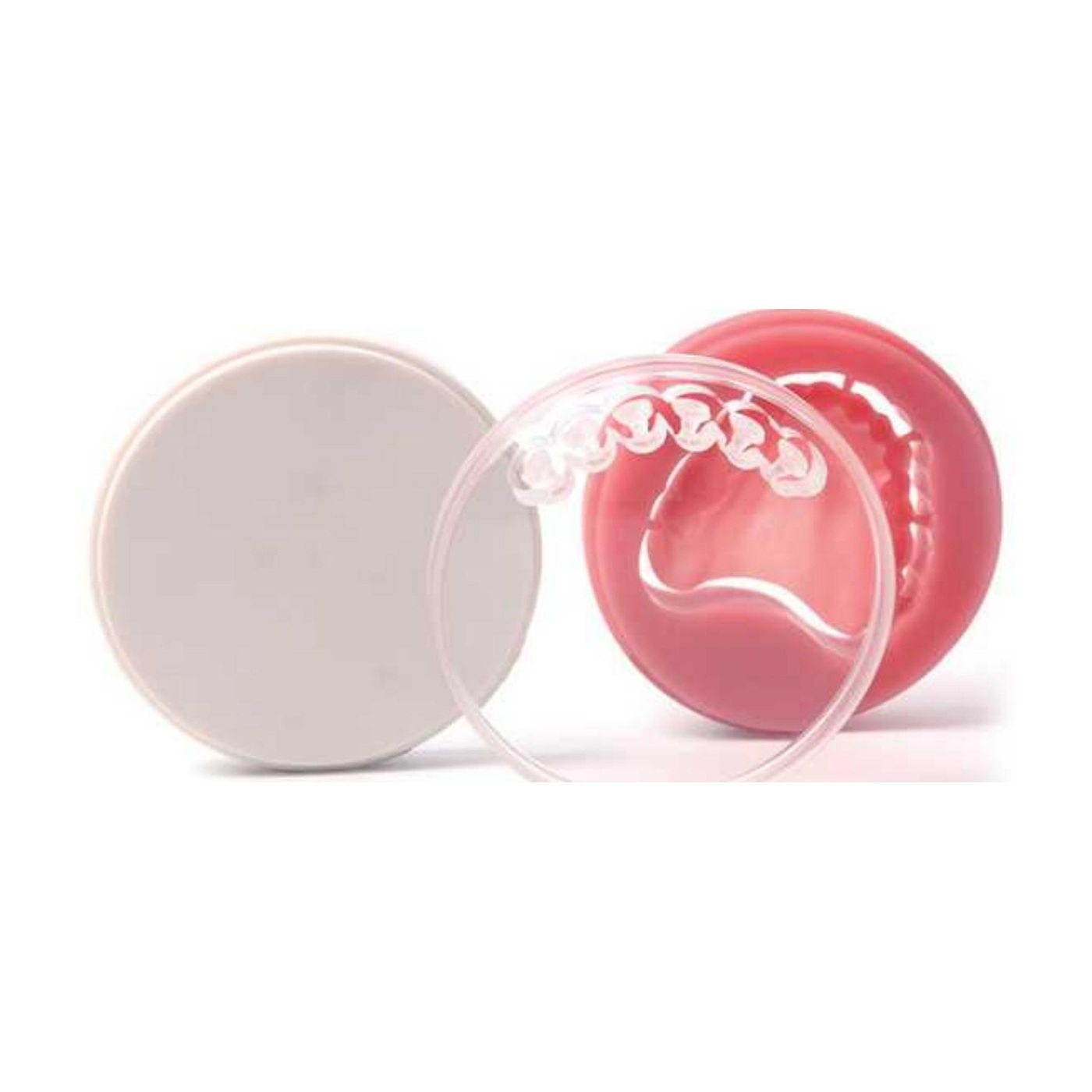
PMMA discs in monolayer, bilayer, multilayer and flexible versions. 98


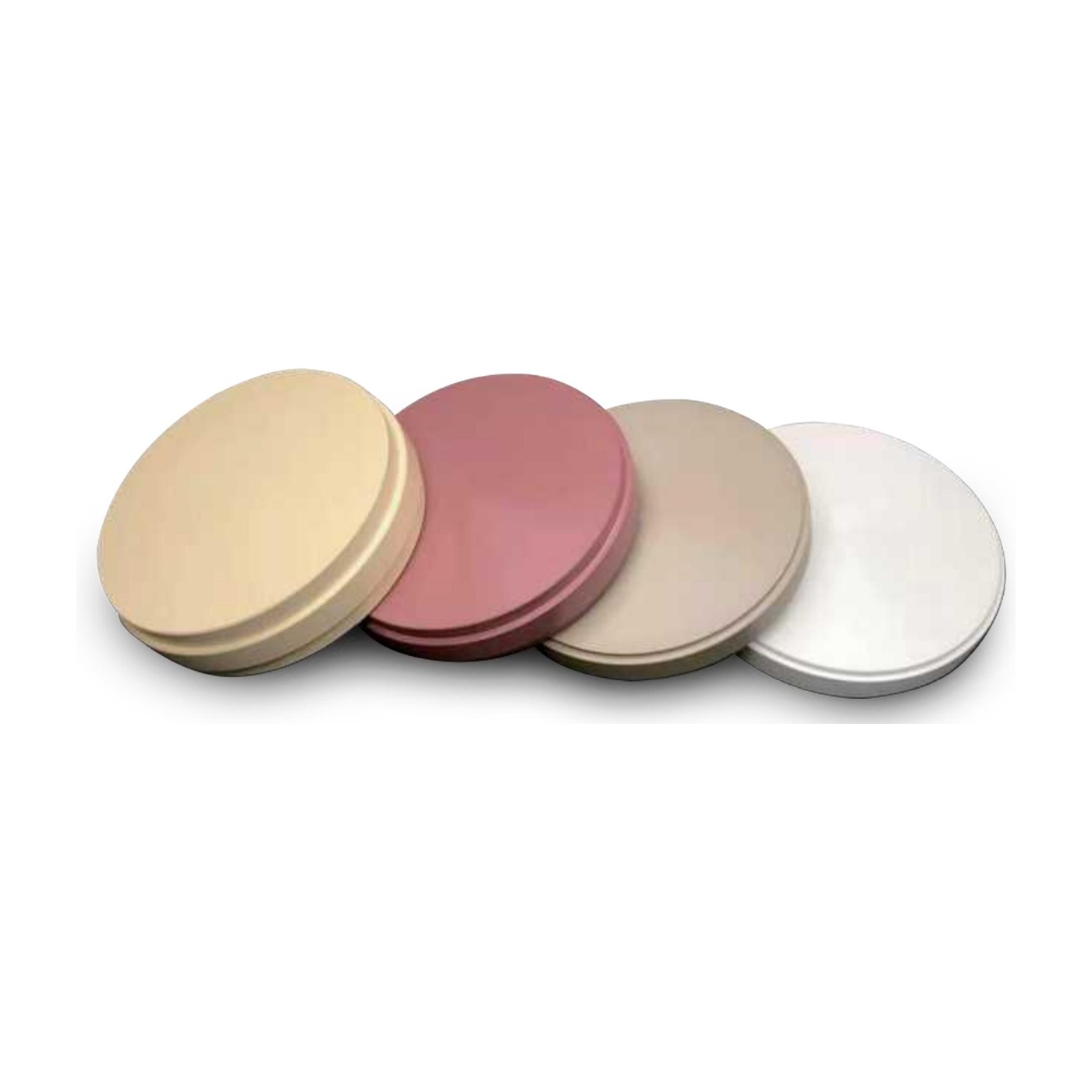
PEEK Disc for Dental CAD/CAM -
PEEK discs for CAD/CAM frameworks, temporary bridges and implant super

Categories
- Endodontics
- Burs, Polishers & Abrasives
- Handpieces & Motors
- Restorative & Prosthodontics
- Imaging & Digital Dentistry
- Orthodontics
- Unit Parts & Accessories
- Dental Instruments
- Implant & Biomaterials
- Preventive & Whitening
- Infection Control & Disposables
- Dental Lab & Materials
- dental equipment
- Loupes & Accessories
Latest News
Contact Us
Contact: Mario
Phone: +8613482534556
Tel: +86-574-62913789
Add: No.33 West Road, Gaoqiao Town, Ningbo, Zhejiang, China